Stocks: Are Plantation stocks still worth looking at (with the current CPO prices hitting new highs)?

We have seen that there are many people calling for "buys" on the plantation sector due to the rising CPO prices. If you wonder where to find out on the latest CPO prices, they are mainly transacted via futures. FCPO is Malaysia's main platform to trade CPO and take delivery in future months. Hence, FCPO remains a good gauge on what will be the price for the future prices of CPO.

Below is the snippets of FCPO prices as of 28/12/2020

FCPO prices taken on 28 December 2020

So, are Plantation stocks a buy now? Let's look at the facts below before we answer the question:

1. Plantation stocks are normally trading below NTA (P/NTA of 0.3 to 0.8 times - depending on plantation size, location of landbank, productivity/age-profile of trees, lands' proximity to development and production cost per tonne). 

2. Plantation stocks are very cyclical and it normally has an uptrend during the CPO commodity price bull runs (due to a swell in earnings and potential dividend). 

3. Some of the Plantation companies like Genting Plantation, IOICorp has emerged into a developer as well due to their land being very close to "development areas". Places like Kulai and Puchong are being developed by Genting Property and IOI Properties as they were ex-estates. 

4. Production costs of FFB (Fresh Fruits Bunches) are estimated to be ~RM1,800. Due to logistical issue, cost structure of some more rural located plantation companies (especially at Sabah, Sarawak) has a slightly higher cost structure. Labour costs in peninsula Malaysia is slightly higher but at East Malaysia logistical issues often balloon the costs and also caused some FFB to degrade (hence commanding lower prices or even being dumped). 

5. Some of the bigger companies like FGV, TSH has landbanks and operations outside Malaysia (mostly all in Indonesia). Sime Darby Plantation has acquired NBPOL in 2015 hence they now operate and own palm oil plantation in Papua New Guinea. 

6. The fruits from the trees can be harvested, sent to the oil palm mill to produce Palm Oil. That is the priced asset. A young tree (normally defined as <7 years old) will yield very little FFB. Trees with age profile of 7 to 12 years old are normally deemed as young matured trees and I have read and seen some producing up to 18 tonnes/ha. The prime is said to be from 10 years of age until 23 years old where they can produce 18 to 25 tonnes of FFB/ha. This is again depending on the tree species. However, the machineries, mills and land cannot be monetize instantly. Land will take a longer time to be monetized as they need to be rezoned for other developments, divided into smaller plots and sold. The process usually take years to complete.

7. 1 tonne of FFB now sells for RM3,800 vs average production costs of RM1,800. The profit is tremendous as compared 9 months ago the average price is <RM2,500/tonne. 

8. Some of the Plantation companies are very illiquid and thinly traded. 

9. Tree stress will normally cause lower production after several months (6-9 months) of good production. Of course, dry weather is another root cause (while wet weather caused floods and harvesting issues leading to eventual reduction in production). This is one good reason on why CPO production and prices is always cyclical.

10. Windfall tax will be activated by Malaysian government (>RM3,000/tonne) and this is also a natural curb in profit. It's reported that in Jan 2021 a 8% Windfall tax will be collected.

Let's see how the companies in Bursa are being valued right now?

A truncated list of Bursa listed Plantation companies (filtered based on Market Cap)

Based on the filtered list above, you can see that the biggest players include Sime Darby Plantation, IOI Corporation, KLK, Genting Plantation is trading at P/B value of >1. One can always argued that the land have not been revalued over the years and if revalued now the book value can be higher, hence reducing the P/B value. 

In terms of P/E ratios, it might not be meaningful as months ago CPO prices were low and naturally profit is bad. 

If you observe well, most of the companies have gone up from their 52 weeks low and now trading almost at their 52 weeks high. 

Concerns

1. The share prices of most Plantation companies have risen and almost at their 52 weeks high. There is always a concern that despite the very likelihood in the hike in profits for the listed Plantation companies, it has already factored in all the good news. When the results come out, not all companies will report terrific profits (due to labour shortage factors, some companies' trees are either too young or old, logistical issues due to bad weather in Q4). Those who reports good profits might not experienced a sharp share price increased. 

2. Some plantation companies like JTiasa etc has pretty weak balance sheet. Some of the East Malaysian companies also involved in timber business and that segment of business wasn't doing well. 

3. Normalization of CPO prices. We can say that prices are market driven, so when prices rises it is due to sustained demand of CPO, the hike in price will dampen demand as well. Lower demand and potentially increase in production in coming months (especially after lots of rain from Sept onwards) could drive prices down.

4. Strengthening of Ringgit against US Dollar might put some pressure on CPO prices. The next edible oil which competes neck-to-neck with Palm Oil is Soybean and it's grown mainly in the West. Buyers buy CPO in USD and hence when RM appreciate, we will have to lower the price to compete with Indonesia.

Outlook? Is it still a buy now?

It is a difficult question to answer but our views are as below.

1. It is still possible to earn 10 - 30% profit by buying into Plantation companies. However, hoping for the stocks to double or triple up might be irrational (might happen in irrational market anyway). 

2. CPO Prices are set to come down after March 2021. The highest should be Jan 2021 which is around RM3,750/tonne.

3. Stocks are trading with a 6 months lookahead. Hence, it might be forecasting a reduction in profit going forward already. A good quarterly result might not help much in stock prices. It's the "Greater Fool's theory" in play right now as we also need to ask ourselves who is willing to buy at a higher prices.

4. If you use the "margin of error" methodology, you might not be comfortable. Margin of error might be lower now due to the price hike. 

5. If you want to take a bet, cherry-picking is the right way forward. Do make sure you read up the production of the Plantation companies (from Bursa's website as all plantation companies are required to post their monthly production figures).

Stocks: Why Index keep going up? And why it's not easy to beat it.

Warren Buffett has once mentioned: "In my view, for most people, the best thing to do is to own the S&P 500 index fund". He further believes that it's very difficult for most people to 'beat the index'. All of us were kind of puzzled and myself included has been asking the question on why is this?

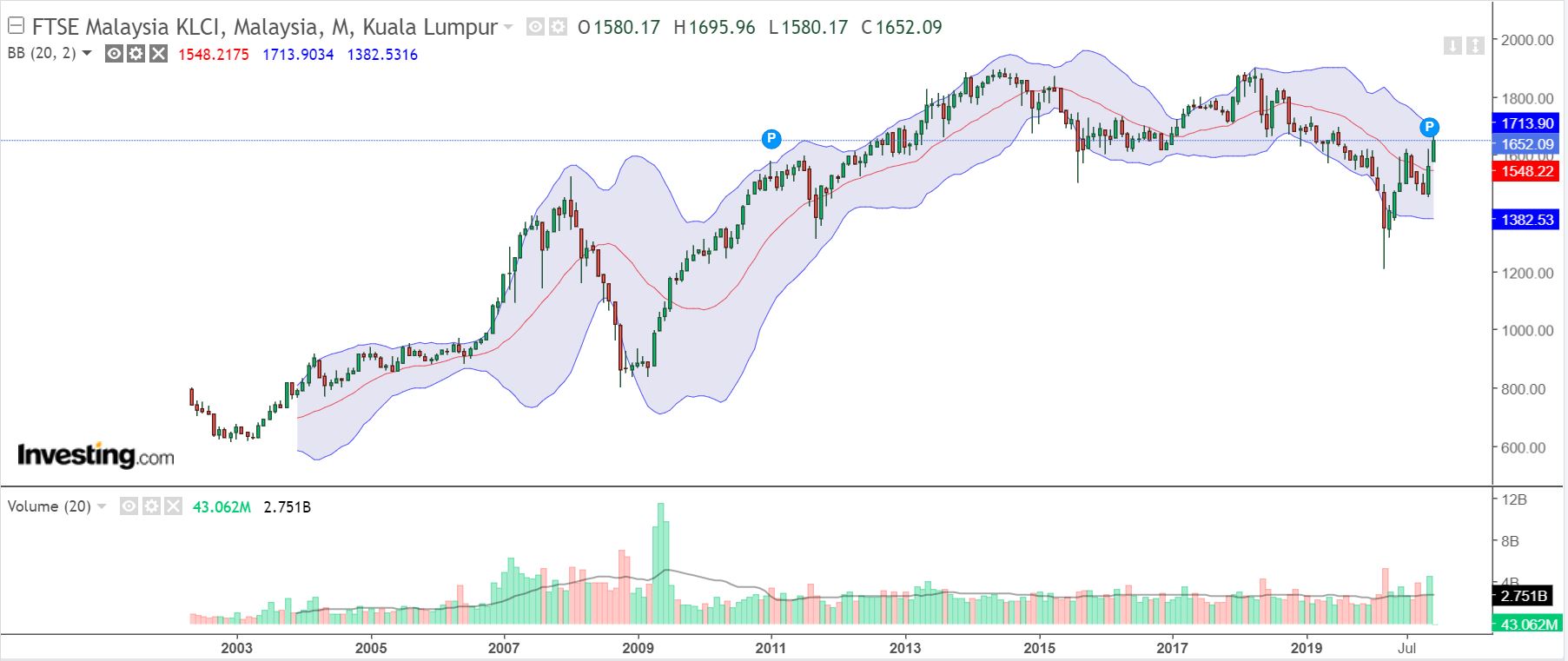
An overview of historical KLCI and S&P500 chart:


After some hard thought process and discussions, we believed that the below are the reasons on why Indexes typically is on a long term uptrend (Japan excluded as they are the only one country in the world which faces long term deflation and hence financial products prices drop):

1. Indexes are being reviewed from time-to-time. Those who did not meet the criteria (i.e. free float, market capitalization) will be eliminated. However, when business is better they might be re-admitted again. Wikipedia (https://en.wikipedia.org/wiki/List_of_S%26P_500_companies) maintains a very good list on the current S&P500 component companies and the updates to it. The review process is already like a 'quality' screening of companies where ailing businesses will be removed and new and thriving businesses will be added.

You can see that only the fittest will "survive" being maintained in the index. This means that it's an auto elimination of businesses that were not doing well, either in the sunset industries or they have lost their competitive edge etc. Also, we know that size matters when it comes to businesses. Although the biggest companies may have higher cost structures and unable to grow as fast as a younger and smaller company, but the mid-to-bigger sized companies (that is likely to be included in S&P500) will have a higher chance of success as they already have competitive edge against their competitors (hence they can grow into the mid-to-bigger size) and have sufficient financial capabilities to do R&D (this is key to survival of a company). 

Notably, due to Technology sector's growth, more and more Technology companies are included into the index while old-school brick and mortar businesses and being kicked out.

2. Companies which are part of indexes are typically 'valued higher', including having higher P/E ratios, P/NTA etc. As index funds these days are gaining momentum, index fund managers have to buy stocks in order for the fund to 'mimic' the index. Hence, there is always demand for index-linked stocks.

3. Index-link stocks and companies does give business partners, investors more confident. Better investors' confidence will lead to point 2 as above while better business partners' confidence will mean that the ability to take loans at a cheaper costs, having slightly longer credit period and better consumers' confidence would also means better sales. 

Tesla, during the early days suffer in brand image and now that it has been included in S&P500 would bring better consumer confidence. The perception will be that it has to be a stable company to be included in S&P500. Similarly, stock prices will take a heavy beating should the stock be removed from the index. Don't be surprised that business might suffer as well post removal from index as customers' perception might be negative towards the company. After all, business is all about 'marketing and image' isn't it?

4. Other than Point 1, most importantly, these big and stable companies keep growing sales and profits, hence their share price keep rising to reflect that. Think of US companies (Google, Amazon, Microsoft, Intel, AMD, Qualcomm, Apple) and Malaysian companies (PB Bank, Maybank, Tenaga, TM, Hong Leong Bank), these companies still manage to grow decently despite their size. 20 years ago we are all talking about Intel Pentium III processor based computers with CRT monitors but today we talked about iPad, Laptops etc. However, companies like Microsoft keep evolving and they have Ms Surface, yearly subscription service of their Office products (Office 365) and offer cloud storage which wasn't in existence 20 years ago. 

For those "old-school" technology companies, they reinvent themselves and came out stronger. For example, Google, Microsoft and Apple reported that "Cloud Computing" is the segment that grows 'double-digit' consistently for the past 3 years. While Google is a newbie but Microsoft and Apple were in computer business since 1970s (the era of Wintel vs Apple). If you look at Microsoft (1986 @ USD21) and Apple (1980 @USD29/share) share price, you will definitely slam the table hard for not putting your money in. After many splits, the USD21 you paid for Microsoft is USD0.10 and at current share price of USD222, it means that a USD1,000 would turn into a hefty USD 2.2mil!

5. The world economy is growing, with exception of Japan where they experienced 20 years of deflation. This will link to the points above that coupled with inflation, profits of companies will keep increasing.

Conclusion
Index investing has not only becoming a trend but for the lazy and less-skilled investor, it become a natural choice. Beating the index is one of the harder things to do as index provides sufficient diversification, 'quality' selection done from time-to-time (i.e. every 3-6 monthly). 


Top 20 Warren Buffett's Famous Quotes

Like I mentioned in my previous articles, there is no "right and wrong" in investment as long as it earns you money. However, there are some notable ways that  you may earn your money in a 'safer manner' rather than relying on lady luck. 

Warren Buffett's investment ideology champions value investing and contrarian investment. Let's see what are Buffett's top 20 famous quotes and remind ourselves again on the basics of investing.

1. Rule No. 1 is never lose money. Rule No. 2 is never forget Rule No. 1.

2. Price is what you pay. Value is what you get.

3. It's far better to buy a wonderful company at a fair price than a fair company at a wonderful price.

4. The key to investing is not assessing how much an industry is going to affect society, or how much it will grow, but rather determining the competitive advantage of any given company and, above all, the durability of that advantage.

5. We simply attempt to be fearful when others are greedy and to be greedy only when others are fearful.

6. The best thing that happens to us is when a great company gets into temporary trouble...We want to buy them when they're on the operating table.

7. Someone's sitting in the shade today because someone planted a tree a long time ago

8. If you aren't willing to own a stock for ten years, don't even think about owning it for ten minutes

9. When we own portions of outstanding businesses with outstanding managements, our favorite holding period is forever

10. I never attempt to make money on the stock market. I buy on the assumption that they could close the market the next day and not reopen it for five years.

11. Should you find yourself in a chronically leaking boat, energy devoted to changing vessels is likely to be a more productive than energy devoted to patching leaks.

12. It takes 20 years to build a reputation and five minutes to ruin it. If you think about that, you'll do things differently.

13. The most important quality for an investor is temperament, not intellect. You need a temperament that neither derives great pleasure from being with the crowd or against the crowd.

14. I believe in giving my kids enough so they can do anything, but not so much that they can do nothing.

15. Don't get caught up with what other people are doing. Being a contrarian isn't the key but being a crowd follower isn't either. You need to detach yourself emotionally.

16. The best chance to deploy capital is when things are going down.

17. Never invest in a business you cannot understand.

18. Risk comes from not knowing what you're doing

19. In the business world, the rearview mirror is always clearer than the windshield

20. Read 500 pages like this every day. That's how knowledge works. It builds up, like compound interest. All of you can do it, but I guarantee not many of you will do it.

Conclusion
His quotes are words of wisdom after over 75 years of investing. One can argue that Buffett lives in an era where inflation, growth, opportunities are all higher and his recent years bet aren't that successful. However, if you read my list of Top 20 Warren Buffett's famous quotes, you will realize that it talks about personal education/learnings, views on risks and how to tackle risks in investment, cutting losses and even money issues in raising kids. 

As a human, I always believed that we ought to review what we have done especially during this year end break and holidays. Review the year and have a vision on the next. All the best folks!

Featured

Market and Economy watch

 1.  https://www.currentmarketvaluation.com/models/buffett-indicator.php AAPL stock chart by TradingView 2. https://financ...