1. https://www.currentmarketvaluation.com/models/buffett-indicator.php
After a year-ish of Coronavirus outbreak, we all know that COVID19 will not end or disappear, but it'll be just like other diseases (think Chicken-pox, Shingles, Influenza A) where vaccine provides a shield or protection to the majority of the population. Some of the virus like small pox or measles have been rare in community after 30-50 years of vaccination programme. Hence, it's childish for us to think that COVID19 is going to go away just like that after the vaccine is being rolled out.
One of the countries which I admire for their technology advancement and survival despite going through never-ending wars - Israel, which Malaysia does not have diplomatic ties with is currently the leader in COVID19 vaccination. As of today (7th Feb 2021), at least 60% of their targeted population have received at least 1 dose of vaccine. I must state that I am not a supporter of Israel but from the viewpoint of a secular and science person, they did very well in many aspects. In this pandemic, the disease outbreak control was not that spectacular but hats off to their vaccination programme. By May 2021, all of their eligible population will be vaccinated.
 |
| A chart of current COVID-19 vaccination status (per 100 people or percentage if you divide by 100) |
To know what it will be like post COVID19 vaccination, we will take a glimpse into Israel's early data (please take note that both Modena and Pfizer mRNA's vaccine which is deemed more superior and newer technology requires 2 doses of vaccine, with the vaccination date 14-21 days apart. It is also mentioned that full protection or benefit should be realized only after a month after the first dose and if you follow up with the 2nd dose). Even with the rapid Israel vaccination, at the end of 1st week of Feb 2021, we know that barely 1/3 of Israel's population fall into the category. However, they are starting to see some benefits like drop in severe illness, hospitalizations, new cases and mortality.


My thoughts after watching Bloomberg's interview with Grantham.
1. He is very thoughtful, straight-forward and managed to summarize what is the market right now.
2. His quote of "High growth stocks is valued higher and normally is based on DCF model or anticipated dividend in future. However, high growth stocks can be overvalued. And if it's overvalued, it's overvalued anyway."
3. He rightly summarizes that "P/B is low because it's sitting on poor quality asset, Dividend Yield is high because it's waiting for a dividend cuts, P/E is low because of poor future earnings visibility".
4. He sees that currently lower growth stocks might overperform the high growth stocks not because of high growth stocks is not growing but it's being overvalued at current prices. Lower growth stocks is trading at way cheaper valuations and has the potential to rise in terms of valuation more (in percentage) than overvalued high growth stocks.
I would encourage you to watch the interview as it offers different viewpoints and watch how Jeremy Grantham argues his points. I find it very impressive and downright truthful.
One of our friends contacted us and discussed about an experience of being scammed. Nothing was lost, fortunately but all the stress and sleepless night endured are a reminder to us that there are certainly many unscrupulous syndicate out there waiting to fish our hard earned money.
Bank Negara Malaysia (BNM) has years ago came out with some remedies and a portal for us to monitor our financial standing. This includes knowing one's payment track record for the past 12 months, total outstanding amount and monthly payment amount. If you've forgotten, it's called the eCCRIS.
Below is a snap shot of eCCRIS and the link to it is https://eccris.bnm.gov.my/eccris/
 |
| Snapshot of eCCRIS of BNM |
From the snapshot above, you can see that the details are being provided:
1. When the credit facility is being approved
2. Name of Financial Institution
3. Is it a Joint or Individual account
4. Financial Institution Branch
5. Account number
6. Total Outstanding
7. Instalment amount
8. Any arrears for the past 12 months (0 means no and 1 means missed or late payment for that particular month)
Just in case you're wondering how the log in page looks like, here you go:
 |
| Log In Page of BNM's eCCRIS |
Guardian pharmacy (or I should call them beauty shop now?) consistently runs promotion throughout the year. I was once told by their staff to watch out for promos on last weekend of the month. So here you go, something that is essential for everyone (sorry except for those who are bald and couldn't use any shampoo).
 |
| 50% off all cosmetics products |
 |
| 50% off all Shampoos and Conditioners |
One of our authors has attended the Phillip Futures Webminar yesterday and they have shared the content via Youtube. Do take note that this is shared by Phillip Futures Sdn Bhd to the public. Ant On The Street shall not be liable for any reader's actions nor take any credit for the viewpoints shared.
Recently Marriot Bonvoy has started to send e-mails to their members on promo on their membership programme. Under their current promo, members are able to speed up the process to earn "Elite Status" - that's what they call for the tiered membership rewards.
Promo #1: Members will be awarded 50% of the Elite nights in Feb 2021, similar to 2020. Under this arrangement, you will get 5 nights if you're Elite Silver, 12 nights if you're Elite Gold or 25 nights if you're Elite Platinum in 2020. This is automatic and elite nights will be credited automatically in Feb 2021.
Promo #2: From 16th Feb till 27th April, all stays with a minimum of 2 nights will be awarded double elite nights and double points. Remember to register for the promo when it's out.
Promo #3: Up to 40% off if booking is made using points during off-peak or low season.


For those who wants to take advantage of the promos above to achieve Platinum status, you may go plan ahead and book 2 nights stay after 16th Feb 2021. With this promo, you will only need 25 nights stay to earn yourself a Platinum status (refer to the perks that comes attached with it) With hotel prices at multi-year low right now, it's never been a better time to go and book yourself some stays and achieve the status that you're aiming for. However, just a word of caution, do take very good care of yourself as COVID19 cases has been in the rise for the past few months.
As we enter into Year 2021 with lots of hope, various world-class analysts has came up with views and expectations for the Year 2021. What I remember clearly in Q3 and Q4 2020, we were often told that World's GDP will be the greatest at 3+%, which is never seen for the past 10 over years. Malaysian economy was 'expected to grow at 7%!'. Fueled with such optimism, we ended Year 2020 with pretty good returns in the stocks and indexes for almost all major stock markets.
However, as the days continue to pass in 2021, we realized that reality is fundamental will 'rationalize' the stock prices. Those who overshot their fundamental will have a pullback and those undervalued ones will play catch up. The recent political developments, rising COVID19 cases and resumption of Regulated Short Selling does a big impact on Malaysian stocks.
In this article, I will share my thoughts and views on how 2021 will likely pan out. None of us have a crystal ball hence we are 'guesstimating' and 'forecasting' and after that place 'our bets' in the stocks or financial instruments that we believe will do well.
1. GDP Growth
My personal view is that the world's GDP will not bounce back >3% as per the optimistic economists think. The reason is due to point no. 2 on vaccine. Demand destruction sometimes is harder to recover and it will definitely take time. However, as Year 2020 caused the world's GDP to drop to a level where we were 2 years ago; from the lower base, it's definitely expected that the world's GDP will continue to rise but at a slightly more moderate ~2.8-3% instead of >3% that some economist forecasted.
The caveat is however if Oil Prices (both Vegetable and Crude) keep increasing, it might cause a higher GDP (as a lot of countries like Saudi, Malaysia, Brunei's GDP as very tied to commodity prices). The more bullish economists of >3% might come true should Crude Oil stayed above USD55bbl and Soy and Palm Oil being the largest vegetable oil stays elevated for a longer period of time.
2. Vaccine and COVID19
The vaccine roll out will be quicker in more developed countries (it's currently proven that mRNA technology is more effective and it needs colder storage temperature). However, the poorer countries will have difficulties accessing. This will continue to cause more lockdowns, more death and lower productivity as work places will need to shut down, movements of people being restricted to slow the spread of the virus.
I believed that COVID19 vaccines based on mRNA will be more successful than the traditional approach of muted virus and cause less side-effects. The downside is the logistical and storage temperature challenge. It will hence take a longer time and benefits the larger, more advance economies. Due to this, more advanced countries will get to move around earlier (will lead to faster economic recovery) vs poorer and less developed economies.
3. Political Stability
US Presidential election just ended with Joe Biden set to be next President. There will be some changes to policies but it seems at the moment that US "fight against China" will continue. It is expected that any maneuvers be more predictable and not as chaotic as before (i.e. officials being sacked via Tweets).
Malaysian Politics will continue to see a lot of changes, volatility and a big potential of GE15. Sarawak election might coincide with GE15 but all depends on the COVID19 cases and vaccination programme. Until a stable political alliances is found between PKR, DAP, PAS, UMNO, Bersatu, GPS etc and proven that the coalition can work, it'll continue to be chaotic and unstable. The results coming from GE15 will lay a foundation on whether the cooperation might continue or not.
Worldwide wise, it'll continue to see some volatility and changes in political arena. However, with the big brother US and China now seems to have a more stable political footing, it can be seen that policies making and agreements can be expedited or discussed extensively, which is good for world economy.
4. Defaults/Shocks
There is an inherent risks of continued defaults especially in the SME arena. Also, in industries like Travel, Tourism, Restaurants and Hotels, Airlines which are hit the worst. The trend might continue and the increased in debt (due to debt payment deferment) will continue to 'haunt' the industry as they will have more debts to service going forward.
Remember that any form of loan moratorium is just to defer your payments but the outstanding amount will increase. This although will bring hard hit companies through the 'winter' but they will spend a bigger amount of profit paying back debt later on.
5. Tourism
Tourism sectors including airlines and restaurants will continue to suffer at least for 1H 2021. Local tourism will resume first, estimated to be from May-June 2021 for more advance countries and year-end for poorer countries due to the slowness in the reach of the vaccines.
International Travel is expected to restart in Q4 2021 but destination will be the more developed countries where the majority of the population has gone through vaccination. Countries who still have not vaccinate at least 80% of their population might face difficulties in attracting quality tourists and will have to rely on neighbouring countries or domestic tourists.
We have seen that there are many people calling for "buys" on the plantation sector due to the rising CPO prices. If you wonder where to find out on the latest CPO prices, they are mainly transacted via futures. FCPO is Malaysia's main platform to trade CPO and take delivery in future months. Hence, FCPO remains a good gauge on what will be the price for the future prices of CPO.
Below is the snippets of FCPO prices as of 28/12/2020
 |
| FCPO prices taken on 28 December 2020 |
So, are Plantation stocks a buy now? Let's look at the facts below before we answer the question:
1. Plantation stocks are normally trading below NTA (P/NTA of 0.3 to 0.8 times - depending on plantation size, location of landbank, productivity/age-profile of trees, lands' proximity to development and production cost per tonne).
2. Plantation stocks are very cyclical and it normally has an uptrend during the CPO commodity price bull runs (due to a swell in earnings and potential dividend).
3. Some of the Plantation companies like Genting Plantation, IOICorp has emerged into a developer as well due to their land being very close to "development areas". Places like Kulai and Puchong are being developed by Genting Property and IOI Properties as they were ex-estates.
4. Production costs of FFB (Fresh Fruits Bunches) are estimated to be ~RM1,800. Due to logistical issue, cost structure of some more rural located plantation companies (especially at Sabah, Sarawak) has a slightly higher cost structure. Labour costs in peninsula Malaysia is slightly higher but at East Malaysia logistical issues often balloon the costs and also caused some FFB to degrade (hence commanding lower prices or even being dumped).
5. Some of the bigger companies like FGV, TSH has landbanks and operations outside Malaysia (mostly all in Indonesia). Sime Darby Plantation has acquired NBPOL in 2015 hence they now operate and own palm oil plantation in Papua New Guinea.
6. The fruits from the trees can be harvested, sent to the oil palm mill to produce Palm Oil. That is the priced asset. A young tree (normally defined as <7 years old) will yield very little FFB. Trees with age profile of 7 to 12 years old are normally deemed as young matured trees and I have read and seen some producing up to 18 tonnes/ha. The prime is said to be from 10 years of age until 23 years old where they can produce 18 to 25 tonnes of FFB/ha. This is again depending on the tree species. However, the machineries, mills and land cannot be monetize instantly. Land will take a longer time to be monetized as they need to be rezoned for other developments, divided into smaller plots and sold. The process usually take years to complete.
7. 1 tonne of FFB now sells for RM3,800 vs average production costs of RM1,800. The profit is tremendous as compared 9 months ago the average price is <RM2,500/tonne.
8. Some of the Plantation companies are very illiquid and thinly traded.
9. Tree stress will normally cause lower production after several months (6-9 months) of good production. Of course, dry weather is another root cause (while wet weather caused floods and harvesting issues leading to eventual reduction in production). This is one good reason on why CPO production and prices is always cyclical.
10. Windfall tax will be activated by Malaysian government (>RM3,000/tonne) and this is also a natural curb in profit. It's reported that in Jan 2021 a 8% Windfall tax will be collected.
Let's see how the companies in Bursa are being valued right now?
 |
| A truncated list of Bursa listed Plantation companies (filtered based on Market Cap) |
Based on the filtered list above, you can see that the biggest players include Sime Darby Plantation, IOI Corporation, KLK, Genting Plantation is trading at P/B value of >1. One can always argued that the land have not been revalued over the years and if revalued now the book value can be higher, hence reducing the P/B value.
In terms of P/E ratios, it might not be meaningful as months ago CPO prices were low and naturally profit is bad.
If you observe well, most of the companies have gone up from their 52 weeks low and now trading almost at their 52 weeks high.
Concerns
1. The share prices of most Plantation companies have risen and almost at their 52 weeks high. There is always a concern that despite the very likelihood in the hike in profits for the listed Plantation companies, it has already factored in all the good news. When the results come out, not all companies will report terrific profits (due to labour shortage factors, some companies' trees are either too young or old, logistical issues due to bad weather in Q4). Those who reports good profits might not experienced a sharp share price increased.
2. Some plantation companies like JTiasa etc has pretty weak balance sheet. Some of the East Malaysian companies also involved in timber business and that segment of business wasn't doing well.
3. Normalization of CPO prices. We can say that prices are market driven, so when prices rises it is due to sustained demand of CPO, the hike in price will dampen demand as well. Lower demand and potentially increase in production in coming months (especially after lots of rain from Sept onwards) could drive prices down.
4. Strengthening of Ringgit against US Dollar might put some pressure on CPO prices. The next edible oil which competes neck-to-neck with Palm Oil is Soybean and it's grown mainly in the West. Buyers buy CPO in USD and hence when RM appreciate, we will have to lower the price to compete with Indonesia.
Outlook? Is it still a buy now?
It is a difficult question to answer but our views are as below.
1. It is still possible to earn 10 - 30% profit by buying into Plantation companies. However, hoping for the stocks to double or triple up might be irrational (might happen in irrational market anyway).
2. CPO Prices are set to come down after March 2021. The highest should be Jan 2021 which is around RM3,750/tonne.
3. Stocks are trading with a 6 months lookahead. Hence, it might be forecasting a reduction in profit going forward already. A good quarterly result might not help much in stock prices. It's the "Greater Fool's theory" in play right now as we also need to ask ourselves who is willing to buy at a higher prices.
4. If you use the "margin of error" methodology, you might not be comfortable. Margin of error might be lower now due to the price hike.
5. If you want to take a bet, cherry-picking is the right way forward. Do make sure you read up the production of the Plantation companies (from Bursa's website as all plantation companies are required to post their monthly production figures).
Warren Buffett has once mentioned: "In my view, for most people, the best thing to do is to own the S&P 500 index fund". He further believes that it's very difficult for most people to 'beat the index'. All of us were kind of puzzled and myself included has been asking the question on why is this?
An overview of historical KLCI and S&P500 chart:

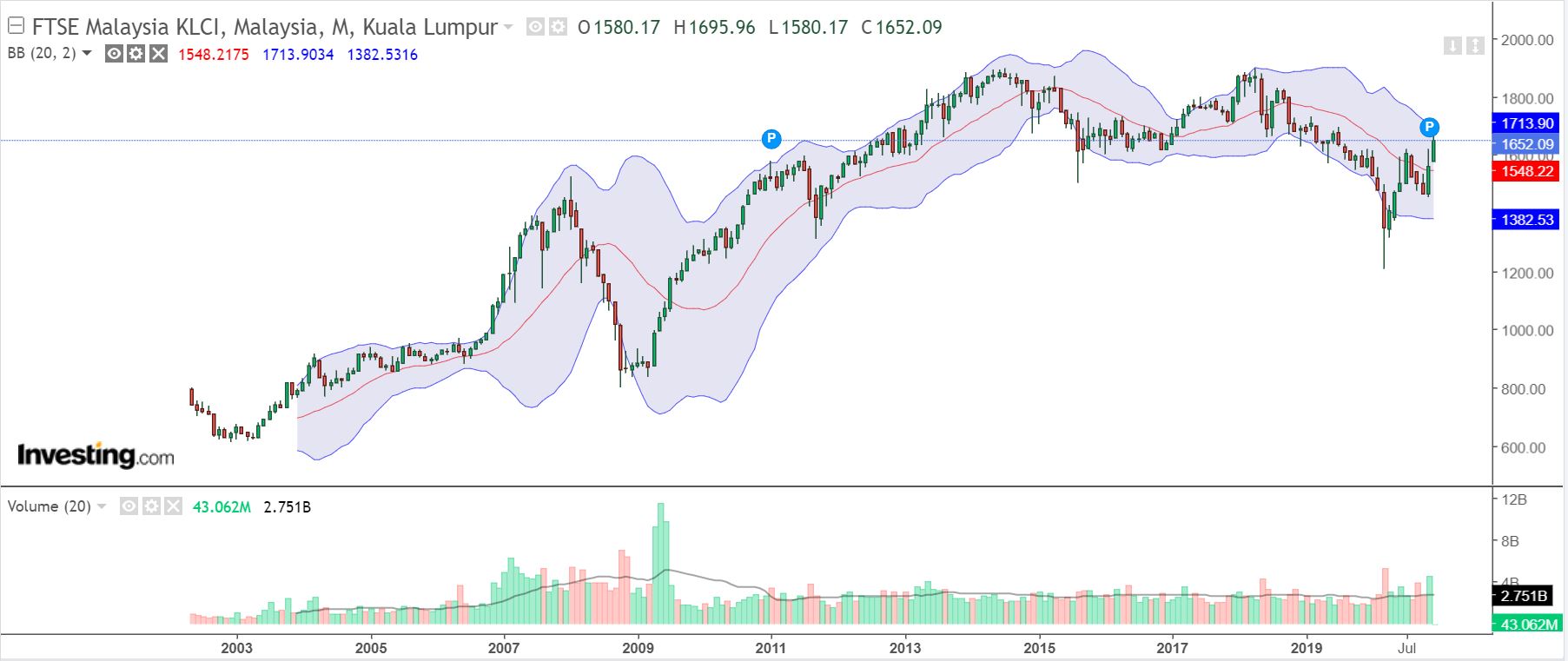
After some hard thought process and discussions, we believed that the below are the reasons on why Indexes typically is on a long term uptrend (Japan excluded as they are the only one country in the world which faces long term deflation and hence financial products prices drop):
1. Indexes are being reviewed from time-to-time. Those who did not meet the criteria (i.e. free float, market capitalization) will be eliminated. However, when business is better they might be re-admitted again. Wikipedia (https://en.wikipedia.org/wiki/List_of_S%26P_500_companies) maintains a very good list on the current S&P500 component companies and the updates to it. The review process is already like a 'quality' screening of companies where ailing businesses will be removed and new and thriving businesses will be added.
You can see that only the fittest will "survive" being maintained in the index. This means that it's an auto elimination of businesses that were not doing well, either in the sunset industries or they have lost their competitive edge etc. Also, we know that size matters when it comes to businesses. Although the biggest companies may have higher cost structures and unable to grow as fast as a younger and smaller company, but the mid-to-bigger sized companies (that is likely to be included in S&P500) will have a higher chance of success as they already have competitive edge against their competitors (hence they can grow into the mid-to-bigger size) and have sufficient financial capabilities to do R&D (this is key to survival of a company).
Notably, due to Technology sector's growth, more and more Technology companies are included into the index while old-school brick and mortar businesses and being kicked out.
2. Companies which are part of indexes are typically 'valued higher', including having higher P/E ratios, P/NTA etc. As index funds these days are gaining momentum, index fund managers have to buy stocks in order for the fund to 'mimic' the index. Hence, there is always demand for index-linked stocks.
3. Index-link stocks and companies does give business partners, investors more confident. Better investors' confidence will lead to point 2 as above while better business partners' confidence will mean that the ability to take loans at a cheaper costs, having slightly longer credit period and better consumers' confidence would also means better sales.
Tesla, during the early days suffer in brand image and now that it has been included in S&P500 would bring better consumer confidence. The perception will be that it has to be a stable company to be included in S&P500. Similarly, stock prices will take a heavy beating should the stock be removed from the index. Don't be surprised that business might suffer as well post removal from index as customers' perception might be negative towards the company. After all, business is all about 'marketing and image' isn't it?
4. Other than Point 1, most importantly, these big and stable companies keep growing sales and profits, hence their share price keep rising to reflect that. Think of US companies (Google, Amazon, Microsoft, Intel, AMD, Qualcomm, Apple) and Malaysian companies (PB Bank, Maybank, Tenaga, TM, Hong Leong Bank), these companies still manage to grow decently despite their size. 20 years ago we are all talking about Intel Pentium III processor based computers with CRT monitors but today we talked about iPad, Laptops etc. However, companies like Microsoft keep evolving and they have Ms Surface, yearly subscription service of their Office products (Office 365) and offer cloud storage which wasn't in existence 20 years ago.
For those "old-school" technology companies, they reinvent themselves and came out stronger. For example, Google, Microsoft and Apple reported that "Cloud Computing" is the segment that grows 'double-digit' consistently for the past 3 years. While Google is a newbie but Microsoft and Apple were in computer business since 1970s (the era of Wintel vs Apple). If you look at Microsoft (1986 @ USD21) and Apple (1980 @USD29/share) share price, you will definitely slam the table hard for not putting your money in. After many splits, the USD21 you paid for Microsoft is USD0.10 and at current share price of USD222, it means that a USD1,000 would turn into a hefty USD 2.2mil!
5. The world economy is growing, with exception of Japan where they experienced 20 years of deflation. This will link to the points above that coupled with inflation, profits of companies will keep increasing.
Conclusion
Index investing has not only becoming a trend but for the lazy and less-skilled investor, it become a natural choice. Beating the index is one of the harder things to do as index provides sufficient diversification, 'quality' selection done from time-to-time (i.e. every 3-6 monthly).
Like I mentioned in my previous articles, there is no "right and wrong" in investment as long as it earns you money. However, there are some notable ways that you may earn your money in a 'safer manner' rather than relying on lady luck.
Warren Buffett's investment ideology champions value investing and contrarian investment. Let's see what are Buffett's top 20 famous quotes and remind ourselves again on the basics of investing.
1. Rule No. 1 is never lose money. Rule No. 2 is never forget Rule No. 1.
2. Price is what you pay. Value is what you get.
3. It's far better to buy a wonderful company at a fair price than a fair company at a wonderful price.
4. The key to investing is not assessing how much an industry is going to affect society, or how much it will grow, but rather determining the competitive advantage of any given company and, above all, the durability of that advantage.
5. We simply attempt to be fearful when others are greedy and to be greedy only when others are fearful.
6. The best thing that happens to us is when a great company gets into temporary trouble...We want to buy them when they're on the operating table.
7. Someone's sitting in the shade today because someone planted a tree a long time ago
8. If you aren't willing to own a stock for ten years, don't even think about owning it for ten minutes
9. When we own portions of outstanding businesses with outstanding managements, our favorite holding period is forever
10. I never attempt to make money on the stock market. I buy on the assumption that they could close the market the next day and not reopen it for five years.
11. Should you find yourself in a chronically leaking boat, energy devoted to changing vessels is likely to be a more productive than energy devoted to patching leaks.
12. It takes 20 years to build a reputation and five minutes to ruin it. If you think about that, you'll do things differently.
13. The most important quality for an investor is temperament, not intellect. You need a temperament that neither derives great pleasure from being with the crowd or against the crowd.
14. I believe in giving my kids enough so they can do anything, but not so much that they can do nothing.
15. Don't get caught up with what other people are doing. Being a contrarian isn't the key but being a crowd follower isn't either. You need to detach yourself emotionally.
16. The best chance to deploy capital is when things are going down.
17. Never invest in a business you cannot understand.
18. Risk comes from not knowing what you're doing
19. In the business world, the rearview mirror is always clearer than the windshield
20. Read 500 pages like this every day. That's how knowledge works. It builds up, like compound interest. All of you can do it, but I guarantee not many of you will do it.
Conclusion
His quotes are words of wisdom after over 75 years of investing. One can argue that Buffett lives in an era where inflation, growth, opportunities are all higher and his recent years bet aren't that successful. However, if you read my list of Top 20 Warren Buffett's famous quotes, you will realize that it talks about personal education/learnings, views on risks and how to tackle risks in investment, cutting losses and even money issues in raising kids.
As a human, I always believed that we ought to review what we have done especially during this year end break and holidays. Review the year and have a vision on the next. All the best folks!
The authors of Ant On The Street Blog would like to wish everyone a Merry Christmas and Happy Holidays!
Meanwhile, stay tuned for more blog entries.

In my previous article, we discussed about What Moves Share Prices. In that article, it is mentioned that Sentiments that is the key factor that affects and moves share prices. Now, knowing that the main contributor of share price movement is due to sentiment, how can we benefit from it? Remember one of the main mantra of Value Investing is "Price is what you pay and Value is what you get".
I personally champion fundamental analysis and also a believer of Value Investing. However, since sentiment is not quite fundamental but it has to do with human behaviors and psychology, I will use mainly Technical Analysis method to select stocks and look out for opportunities.
1. Buy on Dips (if the overall market is on an uptrend)
If the investor has identified that the market is on a recovery and uptrend, buying during any dip is a feasible and proven option. As markets don't go up in a straight line, it's imperative that it'll correct itself once in a while and provide investors a good entry point to accumulate more shares. Normally in an uptrend market, actual data will provide support to the higher valuation and continuity of the bull market.

2. Buy on Price Irrationality (a combination of fundamental and technical analysis)
Often, there are companies that are selling below their intrinsic value. Some examples include property developers like SP Setia, Sime Property of even Banks like Ambank, CIMB, Affin Bank selling at 0.3 to 0.7 times of the book value. The prices are beaten down because of slow sales and anticipated massive impairments. However, if one were to look further and past the pain, most of these companies will bounce back strongly and valuation will rise certainly.
3. Buy on Supports (Technical Analysis) I will not go in too detail as it involves a separate lesson on how to use each of the indicators (or a combination of them) effectively. Some examples as below:
a. Using Bollinger Band

b. Using RSI (oversold region <30%)

c. Using Stochastic

4. Using Contrarian Investing Strategy
Contrarian Investing is an investment strategy that is characterized by purchasing and selling in contrast to the prevailing sentiment of the time. A contrarian believes that certain crowd behavior among investors can lead to exploitable mis-pricings in securities. I have been using this strategy for over 12 years and it has been proven to be very profitable.
However, risk management is key as when market sours, it normally means that businesses are suffering. This means that there will be some companies who will be bankrupt during the downturn. So, in order to exploit this method, you will have to study the balance sheet and fundamentals of the companies before you invest in them. This strategy involves buying companies' shares when stock market is having 'big discounts' (think of massive clearance sales) and hold them over a period of 2-5 years.
Conclusion
The above are some examples of strategies can be employed to profit from the stock markets. In the traditional market (non derivatives or structured products), the only way to profit is to "buy low sell high". For more advance or sophisticated investors, you may explore further instruments like warrants and futures which would allow you to bet both ways (able to profit when market is going up or down). However, the risks associated to it are normally higher as Warrants have an expiry date and normally trading at a premium to the underlying value. While Futures is normally purchased based on calendar month, it has a value (i.e. HKD10 per point for Mini-HangSeng) attached to the points movement. For investors wanting a smaller exposure it might not be suitable.
In business news, we frequently read that stock markets (when we mentioned stock market, we are referring to stock indices) moved >1% a day due to news, incidents, optimism, pessimism etc. The journalists, the authors of news reports or even the wall street bankers will try to 'justify' the movement is due to certain events. You see I use the word "justify" here but not report. The reality is most of us don't know why markets behaved in certain way and certain time but there is only one big logical explanation for it - "sentiment". Of course there are other causes like fundamentals but all these will affect the sentiment that will eventually move the stock price.
Sentiment that moves Stocks
Stocks or Shares are merely "security that represents the ownership of a company". Whenever we buy or sell a stock or share, it simply means that you add on or reduce your 'ownership' of a company. Like what Warren Buffett has mentioned through his Value Investing principle: "Price is what you pay and value is what you get", the intrinsic value of a company don't change day-to-day, not unless there is a major event (i.e. a breakthrough in technology, product development). However, you will occasionally see big swings in stock prices although there is no material development in the fundamental of the companies.
Let's explore how sentiments move stock prices.
1. A positive sentiment will sway the human minds to think that the future of a company or economy is going to be better, hence the investors or traders will think that the future value of a company will increase due to better sales, better profitability. Hence, they are willing to pay more now to get into "position" or "own" the company shares. This will drive up the prices of the stocks as "buyers are more than sellers and sellers can command a better price due to the surge in demand".
2. A negative sentiment will tell the human minds to react in a way to think that there is higher risks ahead, worse days or future that lies ahead for companies and economies. Hence, the reaction will be "I will sell now so that I won't be caught if the gloomy projections does materializes". This causes more people to try to exit a stock even though they are unable to fetch the price they wanted. Hence, a reduction in stock prices is expected.
Based on the above scenarios of the positive and negative sentiments, we can further explore what causes the sentiments to change:
1. News flow (be it fake or real news)
2. Fundamental change (i.e. a company had a breakthrough in a drug trial, better quarterly profit achieved)
3. Macro economy changes - it's expected that if the economy is doing well, most of the companies will do better and vice-versa.
4. Expectation of a significant event or future - for example, the market anticipate Year 2021 to be a recovery year and COVID19 vaccine will assist to clear out the virus risks and reopen economies again. This "expectation" has drive up stock prices worldwide although we have not seen any real successes in any single country by using vaccine to wipe out COVID19 infection risks.
5. Political influence change - as our world relies on the Politicians to make decisions and policies, which will affect businesses dearly, any change in political scenario will cause the sentiment on stock markets to change.
6. Mood - when I say mood here, it's the mood of a group of people or within a region or country. Mood can be affected by many things, including employment, weather, season (i.e. winter, holiday, summer) and profitability from businesses or employment.
7. Natural disasters - the way natural disasters connected to sentiment is always negative (although some companies or countries might benefit from it - i.e. Petronas got a very good deal supplying LNG to Japan post Tsunami that caused Fukushima Nuclear plant to shut and caused a power crisis in Japan. The hike in LNG demand and prices helped many O&G companies operating off Sarawak waters as Sarawak is the biggest LNG producer in the SEA region).
8. Views from Expert, Journalist, Analysts - as surprising as it is, Bloomberg, TheEdge, FT, Morgan Stanley etc reports and views on economies and companies does have an impact that forms view points and it's very much correlated to Point 4 (Expectation). An article from a renowned analyst will definitely swing stock prices but I would argue that the views from each individual analyst only forms a piece of the "Expectation". In order for the reports or views to significantly change the sentiment, it must have the "general consensus" of public.
9. Herd mentality - Humans don't live alone and we are social animals. Sentiments are also affected by herd mentality where a group of people thinking similarly will change the views on certain things. Of course this is normally temporary and will be 'corrected' by fundamentals later on.
From the above, we know that we are unable to control the causes to the change of sentiments and definitely unable to change sentiments as it highly correlates to a "group of majority" of how people think. So how do we benefit from sentiments in stock markets? I will write more on this topic so do stay tuned.
I have recently made a short trip to Melaka and instead of having the usual fun and "go everywhere and eat" trip, I have reduced it with my own "SOP" and "requirements" to reduce COVID19 risks. Spending more time in hotel room is certainly one of the strategy and another one is only to visit during off-peak hours and try to spend less time in restaurants.
I have visited Tong Sheng Restaurant and The Daily Fix Cafe this trip and below are some photos and reviews.
Tong Sheng Restaurant
The restaurant is famous for its Crayfish Cheese Noodles. I was lucky that I came on a Sunday evening and not crowded. I did not pre-book and I managed to get a seat immediately.
I ordered 3 dishes including the famous Cheesy Prawn noodles - a must to try. The other 2 dishes are fried vegetable and salted egg "steam egg" were very good as well. The dent to my wallet is only RM82 which includes 1 bowl of rice and 2 hot chinese tea.
Overall, I must say I enjoyed the food and would definitely come back. The price that they are charging is even cheaper than a standard KL Chinese restaurant and taste is very good. I was told that the crowd at the restaurant is normally huge and was advised to go early, which I did at 5.30pm. During this visit, I saw at least half of the customers are locals.
 |
| Tong Sheng Restaurant |
 |
| Restaurant Interior |
 |
| Story of the founder and the shop |
 |
| "Cheesy Prawn Noodles" |
 |
| I ordered 3 dishes and all of them are delicious |
The Daily Fix Cafe
The cafe opens slightly later at 9am (but I was told they actually open for business before 9am). When I arrived, half of the tables were already. They have the standard cafe offerings like coffee, pancake, cakes, american breakfast etc. Since I had light breakfast prior to the visit, I only ordered a salted gula melaka coffee and a pandan pancake. The pandan pancake is delicious and it's unique (as it's not standard offerings in other cafes). However, I did not get so 'accustomed' to the taste of the Salted Gula Melaka coffee.
The cafe's design and decorations is very picturesque as it has a blend of green old-school sun louvres, red-brown floorings and old solid wood tables and chairs. It gives a very relaxing feel but due to COVID19 risks, I did not feel much of relaxation and it quite defeat the purpose of visiting a cafe (to chill and relax). Anyway, let's have a look at the menu and photos.
 |
| Entrance of The Daily Fix |
 |
| Menu |
 |
| Menu |
 |
| Menu |
 |
| Salted Gula Melaka Coffee |
 |
| Pandan Pancake with Gula Melaka |
I have been one of the many who booked Majestic Hotel Kuala Lumpur and got another night's voucher at Majestic Melaka Hotel. Due to the rising COVID19 cases, I was quite worried initially but was looking forward for a short trip to Melaka. In order to address the COVID19 concern, I have taken a few precautions including not visiting indoor tourist attractions, only visit open air areas and less crowded areas and going for meals extra early (i.e. 5.30pm and 11.30am).
Upon arrival at Majestic Melaka Hotel, I was greeted by the hotel butler who checked my name against his guest list. I was told that I can park my car temporarily near the entrance for check-in. The check-in was immediate and brisk. We were shown to the lift to our room (as the hotel is uniquely designed due to the mix of an old building + modern tower wing). I must say both Majestic Hotels in Kuala Lumpur and Melaka shared the same English style feel and maintain the attraction of having a nice bathtub. They also included a capsule type coffee machine from Boncafe. Although as a coffee lover, I drink Lavazza or Illy regularly and would 'complain' that Boncafe doesn't taste as good, but I suppose the coffee is definitely better than the sachets of Nescafe that we normally see in hotel.
I was given a room at the top floor (Level 10) and it's right in front of the lift. The room is adequately sized (~400sqft) and I must say the views at night is fantastic. The bathroom takes up about 30% of the room space already due to the nice bathtub (that's one of the main selling point of the hotel). However, the utilization of louvered doors (can be fully opened so that you can still look at the TV while soaking in the bathtub) helped in giving the feeling of spaciousness. Let's look at the photos below.
 |
| Exterior of Majestic Hotel |
 |
| Lobby Sitting Area |
 |
| Lobby Sitting Area |
 |
| Lobby Sitting Area |
 |
| Swimming Pool |
The hotel is no doubt small in size but despite the size, the amenities are adequate for guests. Not many who come to Melaka would like to stay just in the hotel (unlike some beach resorts where the whole idea is to go to the beach and stay around the hotel and use the facilities). Most of us would like to venture out and just come back to the hotel for a good rest and chill.
Let's have a closer look at the room.
 |
| Bathroom |
 |
| Minibar and Coffee and Tea |
 |
| Coffee and Tea making facilities |
 |
| Bathroom with nice bathtub |
 |
| View from the room - very scenic night view |
 |
| Bedroom with King bed |
It is no secret that the month of December is experiencing some form of "revenge spending" in Malaysia. The authors of Ant on The Street went to several malls and there were full of people who can't wait to spend the money. Taking advantage of this trend is Mitsui Outlet Park. One of our co-authors went to the mall and was delightfully surprised with the extensive promotions in store.
Look at some of the pictures Mitsui have in their web (https://www.facebook.com/MOPKLIA/)


